How an IME report gets made, and which software does each step
Short version: an IME report passes through 6 jobs: referral and scheduling, record intake, record review, the exam and dictation, drafting, then QA and delivery. No single product does all 6 well. Most practices run 2 or 3 tools.
Before you compare vendors, decide which job is costing you the most hours. For most solo examiners it's record review. For IME companies it's usually scheduling and QA.
Limits: vendor facts come from vendor websites, read 2026-11-08, and were not tested by us. Prices change. How we checked.
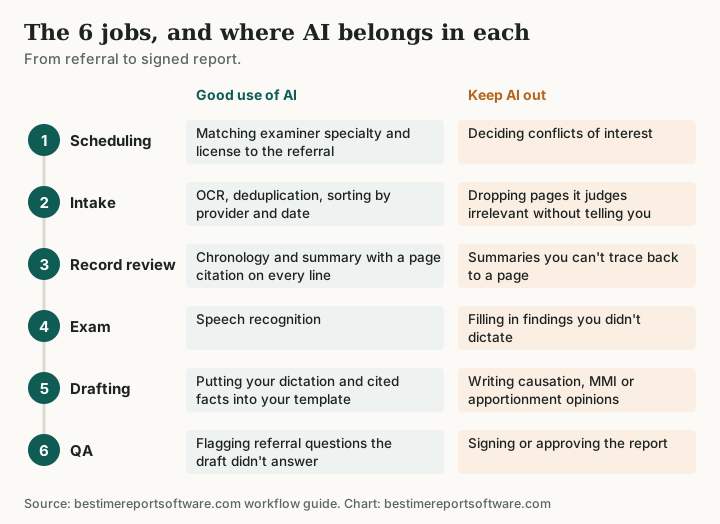
The 6 jobs at a glance:
- Referral and scheduling: case management platforms.
- Record intake: upload portals, OCR, page deduplication.
- Record review and summary: AI record review tools.
- The exam and dictation: speech recognition and transcription.
- Report drafting: templates and drafting tools.
- QA, signature, delivery and billing: usually the case management platform plus a person.
1. Referral and scheduling
A request comes in from an insurer, a third-party administrator, an employer or an attorney. Someone then:
- checks for conflicts of interest;
- matches the claimant to an examiner with the right specialty and license;
- books the exam and an interpreter if needed;
- sends the notices the jurisdiction requires.
Software for this job: IME case management and scheduling platforms. They track each referral from intake to invoice and usually include a client portal. This is the job IME companies care about most, because it's where missed deadlines come from.
2. Record intake
Records arrive as PDFs, faxes and disc images, often from 5 or more sources. A workers' comp file can run past 2,000 pages, and a large share of that is duplicate pages: the same office note faxed 3 times, the same MRI report in 2 provider bundles.
Software for this job: secure upload portals, OCR, page deduplication and indexing. Ask whether duplicates are removed before you're charged, and whether the index survives into the final report.
3. Record review and summary
This is the slowest job for most examiners. You need, in date order:
- the treatment history and every diagnosis;
- imaging findings;
- work status changes;
- prior injuries and gaps in care.
The referral questions usually hinge on 4 or 5 pages buried somewhere in the stack.
Software for this job: AI record review tools that build a chronology and summary. The one test that matters: can you click any line and land on the source page? A summary without page citations moves the reading problem; it doesn't solve it, because you still have to verify every line by hand before you rely on it under oath.
4. The exam and dictation
History, physical findings, range of motion, testing. Most examiners dictate. Some type into a template during or after the exam.
Software for this job: speech recognition and medical transcription. Some IME platforms bundle a transcription service; others export audio to an outside transcriptionist.
5. Report drafting
The report answers the referral questions: diagnosis, causation, whether treatment was reasonable, maximum medical improvement, apportionment, impairment rating, work restrictions, future care. The format depends on the jurisdiction and often on the client.
Software for this job: template libraries and drafting tools that pull the exam dictation and record findings into your format. The opinions are yours (see causation and MMI in the glossary). A tool can assemble the facts and the structure; it should never supply the medical opinion, and you should be able to see which source page every factual sentence came from.
6. QA, signature, delivery and billing
A second reader checks the report against the referral questions and the client's rules. The examiner signs. The report goes out by the deadline, and addenda follow when new records arrive. Then the invoice.
Software for this job: the case management platform from step 1 usually handles delivery and billing. QA is often a checklist plus a person.
Where AI helps, and where it should stay out
| Job | Good use of AI | Keep it out |
|---|---|---|
| Scheduling | Matching examiner specialty and license to the referral | Deciding conflicts of interest |
| Intake | OCR, deduplication, sorting by provider and date | Dropping pages it judges irrelevant without telling you |
| Record review | Chronology and summary with a page citation on every line | Summaries you can't trace back to a page |
| Exam | Speech recognition | Filling in findings you didn't dictate |
| Drafting | Putting your dictation and cited facts into your template | Writing causation, MMI or apportionment opinions |
| QA | Flagging referral questions the draft didn't answer | Signing or approving the report |
Which job to fix first
Track 5 recent reports. For each, write down hours spent in 4 columns:
| Column | What to count | If it's the biggest, start with |
|---|---|---|
| Records | Reading, sorting and summarizing the file | An AI record review tool with page citations |
| Exam | Time with the claimant plus dictation | Speech recognition or a transcription service |
| Drafting | Turning notes into the report format | A template or drafting tool that keeps your format |
| QA and admin | Back-and-forth, addenda, scheduling, invoices | A case management platform |
The checklist lists what to ask vendors for each job, the vendor table shows which job each product covers, and the pricing page shows what each one costs.
Questions about the IME report workflow
How many tools does an IME practice need?
Usually 2 or 3. A case management platform runs scheduling, delivery and billing; a record review tool handles the file; dictation is often separate. See the vendor table for which product covers which job, and the FAQ for short answers.
Which IME job takes the most time?
For most solo examiners it's record review. For IME companies it's usually scheduling and QA, because that's where missed deadlines come from.
Can AI write the IME opinion?
No: causation, MMI, apportionment and impairment are the examiner's opinions, and the examiner signs them. IME software can sort records, cite pages and put your dictation into your template.
What's the 1 test for record review software?
Click any line of the summary. If it doesn't land on the source page, you'll re-read the records before you sign, and the tool saved you little. The trial plan turns this into a 20-line spot check.
Does QA software replace a second reader?
No IME product we found replaces a second reader. QA software can flag referral questions the draft didn't answer, but a person still checks the report against the client's rules before signature.