Best IME report software (2026)
Answer in brief: no single IME report software is best, because the products do different jobs. Pick by the job that costs you the most hours:
- Reading the records (self-serve, page-cited): InjuryMgmt ($99 a month for 1,500 pages), Dodonai (annual plans), OctopusLM ($0.05 a page prepaid), InPractice (no subscription), MediScan ($169 for 1,200 pages), Medrecords AI (ours, deduplicated pages only).
- Records, transcript and draft in 1 tool: IME Coach ($229 a month for 3 reports); Long Health's EvalPath (no published price).
- Running the practice (scheduling, forms, billing): IMEridian for a solo examiner (free to 5 exams a month); SimpleExam for California QME and AME.
- New York no-fault and workers' comp: Aequitas ($199 per IME report).
- Handing the file to people: NaviCase ($0.25 a page, 5 business days); LezDo TechMed (48 hours).
- IME company case flow without AI: W5 Case.
- Insurers reading IMEs, not writing them: Wisedocs.
Disclosure: we make Medrecords AI, graded like the rest. Limits: vendor facts come from vendor websites, read 2026-11-08, untested by us. Prices change.
What the top 10 Google results leave out
On 2026-11-08 we pulled the top 10 Google results for "best ime report software" (US) and read every page in full. Then we did the same for Brave and for 3 related searches ("ime report software", "ime report writing software", "ai for ime"), 33 pages in all. What we found:
- 0 of the 10 Google results publish a single software price. Across all 33 pages, 1 page (imecoach.com) lists any software prices at all.
- None of the 10 compares named products side by side. 4 are vendor pages selling their own tool (Dodon, LongHealth, Wisedocs, MediScan), 1 is an insurer-side playbook (Nomad Data), 3 are IME service companies (MLP IME, MedSource National, BIC MD), 1 is a report template (SEAK) and 1 is a Reddit question with no answers.
- 2 of Brave's top 4 results for "best ime software" are about keyboards. They rank input method editors, the software that lets you type Chinese or Japanese, not medical exams.
- No page tells you how to test a tool before you trust it. "Test with representative cases" is as far as any of them goes.
So this page does the 4 things those pages skip: it names products, prints dated prices, works out what a file costs, and gives you a trial with a pass mark.
Best IME report software by buyer
| You are | Your bottleneck | Trial first | Why |
|---|---|---|---|
| Solo IME physician, 1 to 2 files a month | Reading records | InjuryMgmt, then OctopusLM | $99 a month covers 1,500 pages; OctopusLM gives 1,000 free trial pages and $0.05 a page prepaid |
| Solo IME physician, 5 or more files a month | Reading records | OctopusLM, InPractice, Medrecords AI (ours) | At volume, per-page and credit pricing beats page-capped plans; compare on 1 closed file |
| Solo examiner who hates admin | Scheduling, forms, invoices | IMEridian | Free up to 5 exams a month, $49 a month unlimited |
| California QME or AME | DWC forms, billing, records | SimpleExam for the practice, plus a record review tool | SimpleExam includes the 2021 Medical-Legal Fee Schedule and an OMFS calculator; it sells record summaries as a service, not software |
| New York no-fault or WC examiner | Report drafting on NY forms | Aequitas | Prices a C-4.3 at $129 and an IME at $199; free during its founding pilot |
| Orthopedic or spine IME with heavy files | Records plus deposition prep | NaviCase | Clinicians write the summary; deposition guides at $0.75 a page |
| IME company with many examiners | Case flow, QA, records | easyIME or IMECore (Canada) | Both cover intake to delivery; neither publishes a price |
| Insurer or TPA reviewing IMEs | Claim files, not report writing | Wisedocs | Built for claims teams; demo only |
The 6 jobs IME software does
An IME report goes through 6 jobs. Most products do 1 or 2 of them well. Comparing a scheduling platform with a record review tool tells you nothing, so start by naming the job.
- Scheduling and case management: referrals, appointments, deadlines, status. IMEridian, SimpleExam, easyIME, IMECore, Docura, Aequitas, W5 Case, Medicoreports.
- Record intake and summary: sorting, removing duplicate pages, a dated chronology, a summary with page citations. InjuryMgmt, OctopusLM, InPractice, MediScan, Dodonai, IME Coach, Long Health, EZ-Medical AI, Wisedocs, Amaise, Docura, easyIME, Aequitas, Medrecords AI (ours), and NaviCase, LezDo TechMed, LevelShift and MOS as services.
- Dictation and transcription: the history and exam in your words. ZyDoc, IME Coach, Long Health, Dodonai, Medicoreports, InjuryMgmt, easyIME, Aequitas, SimpleExam (as a service).
- Report drafting and templates: putting your findings into your format or the state's form. Aequitas, Docura, easyIME, IMEridian, IME Coach, Long Health, Medicoreports, InjuryMgmt (state forms), Medrecords AI (draft built from your notes).
- QA review: checking the draft against the records and the referral questions. Aequitas, easyIME, IMECore, NaviCase, IME Coach (a discrepancies tab), LezDo TechMed and LevelShift (people check the output).
- Delivery and billing: sending the signed report, invoicing, fee schedules. SimpleExam, IMEridian, easyIME, IMECore, Aequitas, W5 Case, Medicoreports.
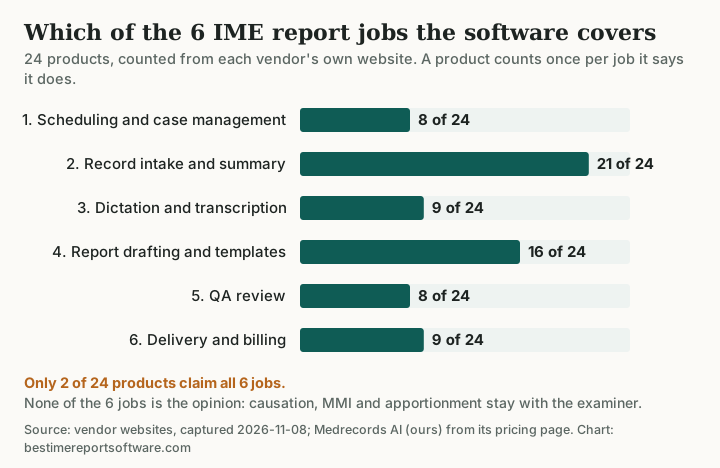
The opinions (causation, MMI, apportionment, impairment) are not on this list. They stay with you. More on that below.
Section by section: where software fits in the report
A standard IME report has the same core sections whatever the state. Here is what a tool can hand you for each, and what you still check.
| Report section | What software can give you | What you check or write |
|---|---|---|
| Referral questions | The questions pulled from the referral letter into a list | That every question gets its own answer |
| Records reviewed | A list of every record with dates and page ranges, plus records mentioned but missing | Whether a missing record changes your opinion |
| History | A transcript of your dictation; a draft history from the records | Every word of the transcript; your own interview |
| Medical record chronology | A dated, page-cited timeline | The lines your opinion rests on |
| Physical exam findings | A template to fill and dictation to text | The exam itself |
| Diagnosis | Prior diagnoses and ICD-10 codes from the records | Your diagnosis |
| Causation and apportionment | Prior injuries and pre-existing conditions with dates | The opinion and its reasoning |
| MMI and permanent impairment | Prior ratings, and AMA Guides tables in tools that have a calculator | The rating and the edition you used |
| Work capacity and restrictions | Every prior restriction and return-to-work date | Current restrictions |
| Treatment recommendations | Treatment to date and what was tried | What is reasonable from here |
Assist, not author. Split tools into 2 kinds before a demo. The first kind gives you material you control: summaries, chronologies, transcripts and drafts you edit. The second kind tries to produce the opinion itself, which you then have to argue with. Buy the first kind. 3 rules follow from that:
- Every drafted section must be editable. You must be able to change or delete any sentence before you sign, in the tool or after export to Word.
- Every dictation transcript gets read. Speech recognition mishears drug names, levels and laterality ("left" for "right"). Read the transcript against your notes and correct it before it goes in the report.
- Nothing goes in unread. If you didn't read a sentence, it doesn't belong in a report you sign.
24 products compared
Every fact comes from the vendor's own website, read on the date shown. "Not published" means we looked for a price page and found none. Full feature grid: vendor table.
| Product | Main job | Published price | Pricing model | Free trial | BAA stated | Source, date |
|---|---|---|---|---|---|---|
| Amaise | Insurer claim files, with an IME center page | Not published | Demo only | No | Not stated | amaise.com, 2026-11-08 |
| Aequitas | NY report drafting | IME $199, C-4.3 $129, narrative $99, H&P $29 | Per report | Free founding pilot | Yes | aequitasmedical.com, 2026-11-08 |
| Dodonai | Record summaries, chronologies, audio transcription | $25, $50 or $83.33 a month, billed annually ($0.063 down to $0.008 a page) | Annual credits | 7 days, 100 pages, no card | Yes | dodon.ai, 2026-11-08 |
| Docura | WC records and QME/IME drafts | Not published | Demo only | No | Not stated | docurahealth.com, 2026-11-08 |
| easyIME | Most of the workflow | Not published | Not published | Not stated | Yes | imewriter.com, 2026-11-08 |
| EZ-Medical AI | Record review | Not published | Not published | First case via contact form | Not stated | ezmedical.ai, 2026-11-08 |
| IME Coach | Records, exam transcript, report draft | $99 a month then $0.17 a page; $229, $749 or $2,970 a month for 3, 8 or 30 reports | Subscription by reports, or per page | First report free, no card | Yes, accepted in the app before upload | imecoach.com, 2026-11-08 |
| IMECore | IME arranging (Canada) | Not published | Per case | Not stated | Not stated | imecore.com, 2026-11-08 |
| IMEridian | Practice and report format | $0, $49, $99 a month | Subscription | Yes | Not stated | meridianime.com, 2026-11-08 |
| InjuryMgmt | Record review plus WC EMR | $99 a month (1,500 pages), $249 (5,000 pages), extra pages $0.05 | Subscription with page cap | 200 pages | Yes | injurymgmt.com, 2026-11-08 |
| InPractice | Record review | $150 per 1,000 pages down to $7,000 per 100,000 | Credit packs, never expire | 500 pages, no card | Yes | inpractice.ai, 2026-11-08 |
| Medrecords AI (ours) | Record review plus a draft from your notes | $0.10 per deduplicated page, report draft $10 | Per page, credits | 7 days, 1 case, 1,000 pages | Yes | our page, 2026-11-05 |
| LevelShift | Record review service | Not published | Service | Not stated | Not stated | levelshift.com, 2026-11-08 |
| LezDo TechMed | Record review service, AI-assisted, people check it | $100 flat up to 100 pages, then $0.75 down to $0.20 a page by file size | Service, per page | Pilot, terms not stated | Not stated | lezdotechmed.com, 2026-11-08 |
| Long Health (EvalPath) | Records, exam scribe, impairment rating, report draft | Not published (lists 1,500 pages a month, no dollar figure) | Not published | Not stated | Policies page only | longhealth.io, 2026-11-08 |
| MediScan | Record review and record Q&A | $169 a month (1,200 pages), $445 (3,500), $665 (10,000) | Subscription with page cap | 15 days | Yes | mediscan.ai, 2026-11-08 |
| Medicoreports | UK medico-legal reports, dictation to report | Free; £19.99 a month; AI report £8 or £5 each | Subscription plus per report | Free plan | Not stated | medicoreports.com, 2026-11-08 |
| MOS Medical Record Review | Record review service plus ReviewGenX | Not published (custom) | Service | On request, terms not stated | Not stated | mosmedicalrecordreview.com, 2026-11-08 |
| NaviCase | Clinician-written summaries | $0.25 a page ($150 minimum), IME prep $0.50 ($500 minimum) | Service, per page | No | Yes | navicasemed.com, 2026-11-08 |
| OctopusLM | Record review | $0.10 a page; $0.05 with a $300 top-up | Per page, prepaid | 1,000 pages | Not stated | octopuslm.co, 2026-11-08 |
| SimpleExam | California practice management | No dollar figures | Pay per use, or contact | Not stated | Not stated | simplexam.com, 2026-11-08 |
| W5 Case | IME company case management, no AI | Not published | Not published | Not stated | Not stated | w5case.com, 2026-11-08 |
| Wisedocs | Insurer claim files | Not published | Demo only | No | Not stated | wisedocs.ai, 2026-11-08 |
| ZyDoc | Dictation (general medical) | About $350 a month (about 100 documents) | Subscription | 7 days | Not stated | zydoc.com, 2026-11-08 |
11 of the 24 publish no dollar price: Amaise, Docura, easyIME, EZ-Medical AI, IMECore, LevelShift, Long Health, MOS, SimpleExam, W5 Case and Wisedocs. Expect a sales call before you see a number. Medicoreports prices in pounds for the UK market; we list it because it says it adapts to the US.
How IME software is priced
4 pricing models show up, and each one wins at a different volume.
- Per page (OctopusLM, Medrecords AI, IME Coach's pay-per-page plan, NaviCase and LezDo TechMed as services): cost tracks file size. Cheapest when your files vary a lot or you do few of them. Ask whether duplicate pages count.
- Credit packs (InPractice, prepaid OctopusLM top-ups, Dodonai's annual credits, Medrecords AI credits): you buy pages up front at a lower rate. Cheapest at steady volume. Check whether credits expire; InPractice says its credits never do.
- Subscription with a page cap (InjuryMgmt, MediScan): a flat monthly fee covers a set number of pages. Cheapest when you use most of the cap every month, and the most expensive per page in a quiet month.
- Per report (Aequitas, IME Coach's report plans, Medicoreports): the price moves little with page count. Aequitas states no page limit; IME Coach uses 1 more credit for each extra 750, 1,000 or 1,500 pages, depending on the plan. Cheapest for thick files, priciest for thin ones.
IMEridian (practice management) and ZyDoc (transcription) charge a monthly fee and don't read records, so they sit next to a record tool, not in place of one.
What a file costs: 500, 2,000 and 5,000 pages
Our arithmetic from each vendor's published prices on 2026-11-08, record summary only, before any rush fee. For page-capped plans we assume this is your only file that month.
| Product | 500 pages | 2,000 pages | 5,000 pages | How we got it |
|---|---|---|---|---|
| OctopusLM, prepaid | $25 | $100 | $250 | $0.05 a page drawn from a $300 top-up |
| OctopusLM, standard | $50 | $200 | $500 | $0.10 a page |
| Medrecords AI (ours), 30% duplicates | $35 | $140 | $350 | $0.10 per deduplicated page; duplicates not billed |
| Medrecords AI (ours), 0 duplicates | $50 | $200 | $500 | $0.10 a page |
| InjuryMgmt | $99 | $124 | $249 | $99 plan + 500 pages at $0.05; $249 plan covers 5,000 |
| Dodonai, annual plan | $31 | $125 | $125 | Share of an annual plan paid up front: Lite ($300 a year, $0.063 a page) up to 2,000 pages, Basic ($600 a year, $0.025 a page) at 5,000; standard summaries only |
| MediScan | $169 | $249 | $549 | Starter $169 covers 1,200 pages, then $0.10 a page |
| IME Coach, pay per page | $99 | $340 | $850 | $99 a month covers about 580 pages, then $0.17 a page; includes a report draft |
| InPractice | $150 | $300 | $600 | Smallest pack that covers the file |
| LezDo TechMed, per case | $375 | $600 | $1,000 | Rate for the file's size band on every page ($0.75, $0.30, $0.20); ask whether bands apply to the whole file |
| NaviCase record summary | $150 | $500 | $1,250 | $0.25 a page, $150 minimum |
| NaviCase IME report prep | $500 | $1,000 | $2,500 | $0.50 a page, $500 minimum |
| Aequitas IME report | $199 | $199 | $199 | Flat per report, any length |
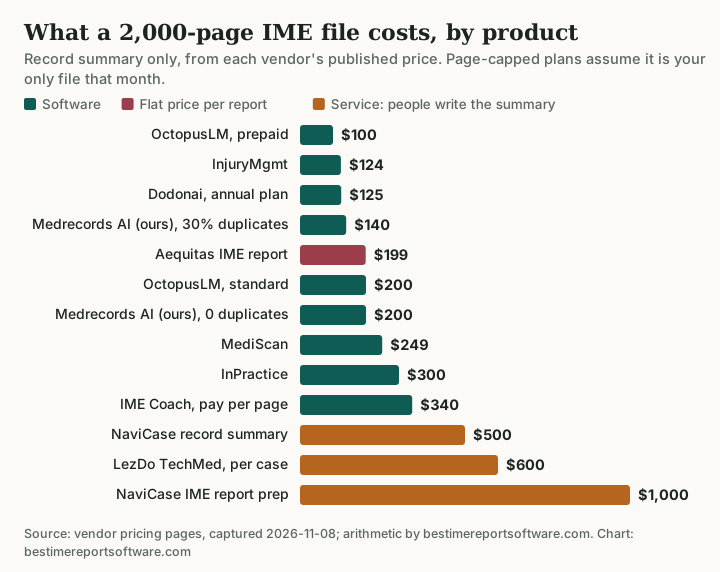
The 30% duplicate rate is an assumption for illustration, not a measured average. Real files vary; records pulled from several providers repeat the same notes, labs and imaging reports. Count yours on 1 closed file before you compare quotes.
Put that next to what the file pays. California's medical-legal fee schedule pays $3.00 per page of records reviewed beyond the first 200 (8 CCR 9795). A 2,000-page QME file pays $5,400 for record review; a 5,000-page file pays $14,400. The software for that file costs $100 to $850. The real cost is your time: at an illustrative 100 pages an hour, 2,000 pages is 20 hours of reading before you see the patient. Use your own pace in that sum.
Duplicate pages: the cost nobody lists
Record sets for IMEs arrive from several sources: each treating provider, the hospital, the carrier, the attorney. The same operative note or MRI report can appear 3 or 4 times. That costs you twice: reading time, and per-page fees on tools that bill every uploaded page.
What to ask a vendor: does the tool flag or remove duplicate pages, and are duplicates billed? IMECore's intake flags likely duplicate cases by claim number and date of birth but never merges them on its own. Medrecords AI (ours) removes duplicate pages before billing. For the others, ask, and test with a file where you know the duplicates.
How fast: minutes for software, days for services
Speed splits along the same line as price. Software returns a summary within about an hour of upload. Services, where people read the records, quote hours or business days. Stated speeds as published on 2026-11-08; none of these are our measurements except our own product's rate.
| Product | Kind | Stated speed | Source |
|---|---|---|---|
| Medrecords AI (ours) | Software | About 1 hour per case on average, measured on client cases | Our product |
| MediScan | Software | Typically 15 to 45 minutes per summary | mediscan.ai |
| ZyDoc | Dictation and transcription | "Under 1 hour" turnaround, vendor claim | zydoc.com |
| LevelShift | Record review service | 24-hour turnaround, vendor claim | levelshift.com |
| LezDo TechMed | Record review service | 48 hours standard | lezdotechmed.com |
| NaviCase | Record review service | 5 business days; next-day rush adds 50% | navicasemed.com |
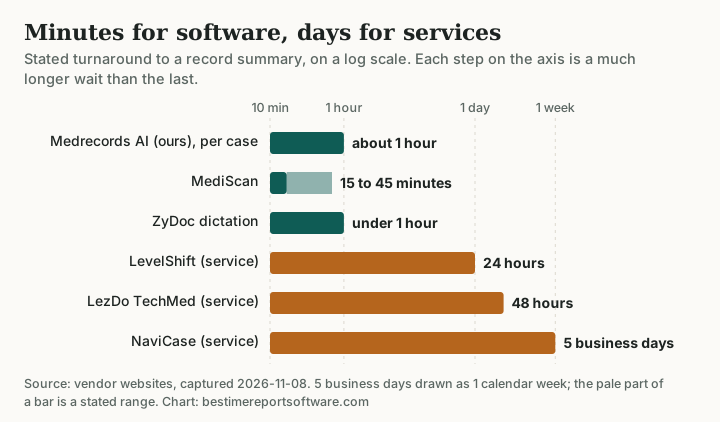
The summary is the fast part. The clock that matters is upload to signed report, and most of it is still yours: checking the cited lines your opinions rest on, the exam, dictation, reading the transcript, and editing the draft.
Software takes the first read of the records off that clock. It does not take the checking off. A service that needs 5 business days can still be the right buy when your bottleneck is a stack of files, not a single urgent one; it is the wrong buy when a deposition date is set.
In your trial, time 2 things on the same closed file: upload to summary, and upload to a report you would sign. The second number is the one to compare with how you work today.
Limits of each product
Every product has gaps. These are the ones a buyer should know before the demo, from each vendor's own site on 2026-11-08.
Record review tools
- Dodonai: plans are billed annually, so you pay up front; advanced analysis costs up to 3 credits a page.
- EZ-Medical AI: no price page and no stated free trial.
- InjuryMgmt: page caps per month; AMA 5th edition impairment rating is in beta.
- InPractice: $0.15 a page in the smallest pack, falling to $0.07 only at 100,000 pages; built for law firms as much as physicians; no report drafting.
- MediScan: page caps per month; no report drafting.
- OctopusLM: no report drafting; the low rate needs a prepaid top-up; Canadian company.
- Medrecords AI (ours): no scheduling, no dictation, no billing or invoicing. It reads records, answers questions about them with page citations, and builds a draft from your notes; you still need a practice tool.
Tools that try to cover most of the workflow
- Aequitas: built around New York forms; free pilot pricing means post-pilot terms are untested. SOC 2 Type II is through its parent company, under NDA.
- easyIME: no price page (/pricing redirects to the homepage).
- IME Coach: a report credit covers 750 pages on Starter, so a 2,000-page file uses 3 of your 3 monthly credits; 3 AI generations per report; voice transcription starts on the $749 plan; founded in 2024, so a short track record.
- Long Health (EvalPath): no dollar price; on 2026-11-08 the report-drafting step on its product page still showed placeholder text.
- Medicoreports: built for the UK MedCo system and priced in pounds; no BAA mention.
- Docura: no price page (it returned 404) and no trial; demo booking only.
Practice and case management
- IMEridian: an iOS app for capture and report formatting; it doesn't read your records and makes no explicit AI claim.
- SimpleExam: California only; record summaries are a paid service, not software; no AI or HIPAA statement on the pages we read.
- W5 Case: no AI and no HIPAA statement on its homepage; it runs IME company logistics, not record review.
Services, transcription and insurer tools
- IMECore: Canada-focused, no HIPAA statement; it is a service with a platform, not self-serve software.
- LevelShift: an IT and Salesforce consultancy that also runs record review; no price, trial or BAA mention.
- LezDo TechMed: 48-hour standard turnaround; the trial is a pilot with no stated limits; no BAA mention on the pages we read.
- MOS Medical Record Review: custom pricing only; its /pricing page is a 2019 post with no figures.
- NaviCase: standard turnaround is 5 business days (next day costs 50% more); no trial; $500 minimum for IME report prep.
- ZyDoc: general medical transcription; its IME specialty page describes autopsy and forensic pathology work, which is a different job.
- Wisedocs: built for insurers and claims teams, not the examining physician; demo only.
- Amaise: built by and for insurance adjusters; its IME page pitches IME centers, but the trial button leads to a demo booking.
What software can and cannot do in an IME
Software can read, sort, extract and format. It cannot examine the patient or own the opinion.
| Task | Software can do it | Stays with the examiner |
|---|---|---|
| Sort and deduplicate records | Yes | Spot-check what was removed |
| Dated chronology of visits, diagnoses, procedures, imaging | Yes, with a source page per line | Verify the lines your opinion rests on |
| Flag missing records, treatment gaps, conflicting findings | Yes, as flags | Decide what they mean |
| Track each referral question | Yes | Answer each 1 |
| History and physical exam | Transcribe your dictation | Take the history, examine the patient |
| Causation, MMI, apportionment, impairment rating, work restrictions | Pull the supporting facts and show the AMA Guides tables | Form and sign every opinion |
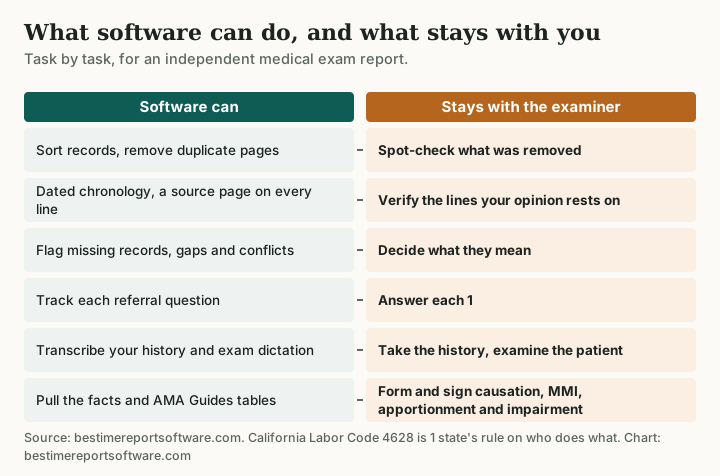
California makes this explicit for medical-legal reports. Labor Code 4628 bars anyone but the signing physician from the nonclerical work on the report: taking the history, reviewing and summarizing prior records, and drafting the conclusions. 3 subdivisions matter for software:
- (c): if the physician didn't excerpt the prior records, the physician must review the excerpts and make whatever further inquiry is needed.
- (b): the report must name each person who performed services on it.
- (e): a report that fails the section is inadmissible and unpaid.
So an AI summary is a starting point you check, never a section you paste. California's Division of Workers' Compensation has said it appears consistent to disclose AI use by naming, at minimum, the program and what it was used for (as quoted by MediScan).
Outside California, rules vary: Wisedocs counts 29 jurisdictions with NAIC AI bulletins or insurance-specific AI rules as of 2026-04-01. Check with your licensing board and with the referral source's contract.
Sample disclosure wording you can adapt: "Records were indexed and summarized with [program name] to build a chronology with page citations. I reviewed the source records, examined the patient, and formed and wrote every opinion in this report."
If you're asked in deposition "did you use AI?" the safe answer is the 1 above, backed by your file: keep the chronology export with its page citations, your notes on which records you read in full, and your edits to any draft. A citation you checked is defensible. A sentence you can't trace to a page is not.
Why not just use ChatGPT?
- No BAA on consumer plans. Uploading a patient's records to a tool without a signed Business Associate Agreement is a HIPAA problem.
- Size. A 2,000-page file is beyond what a chat upload handles in 1 pass, so parts get skipped without telling you.
- No page citations. A chat answer doesn't link each fact to its source page, so you re-read the records to check it.
- No structure. You get prose, not a dated chronology you can export into your report.
Features to look for in AI record review
- Page citation on every line, clickable to the source page.
- Chronology: date-ordered encounters, diagnoses, procedures, imaging and work status.
- Clinical extraction: diagnoses with ICD-10 codes, CPT codes, medications with dose changes, imaging impressions, operative findings, functional status, work restrictions and return-to-work dates.
- OCR for scans, faxes and handwriting, with low-confidence pages flagged instead of guessed. OctopusLM says it does this.
- Deduplication across providers.
- Flags: missing records (a referral mentions an MRI that isn't in the file), gaps in treatment, contradictions between treating providers and prior opinions, and prior IMEs in the file.
- Search and filter by provider, date range or body part, and plain-English questions answered with page citations.
- Apportionment facts: pre-existing conditions and prior injuries pulled out with dates, so you can apportion.
- Export to Word or PDF, into your own template.
- Supplemental records: when new records arrive after the exam, can you add them and see what changed, or do you start over?
- Imaging: most tools read the radiology report text, not the images. easyIME has an in-browser viewer for CT, MRI and X-ray (easyView).
How to check an AI summary before you sign
An AI summary can be wrong in 2 ways: it states something the records don't say (a hallucination), or it leaves out something they do say (an omission). Omissions are worse, because nothing on the page warns you.
- Click every line your opinion rests on through to its source page. If a line has no citation, treat it as unverified.
- Check the facts that move the case: date of injury, mechanism, first complaint of the body part, prior injuries to the same part, surgeries, imaging impressions, work status.
- Search the records yourself for 3 terms the summary should have caught (a prior claim, a pre-existing diagnosis, a gap in treatment).
- Read the pages the tool flagged as unreadable or low confidence.
Do this before you sign, every time. You are the 1 who answers for the report in deposition.
A 1-week trial with a pass mark
Run the same test on 2 or 3 tools so the numbers compare.
- Pick a closed file you already reported on, ideally 1,000 to 2,000 pages with scans and duplicates. Use only records you're allowed to share, and only after the BAA is signed.
- Write down 20 facts you know are in the file before you upload: dates, diagnoses, surgeries, prior injuries, restrictions, and 2 facts buried in handwriting.
- Time it from upload to a usable chronology.
- Score it: how many of the 20 facts it found, how many citations land on the right page, and anything it stated that isn't in the records.
- Set the bar before you look: for example, at least 18 of 20 facts, every checked citation on the right page, 0 invented facts.
- Check the cost for that file at the vendor's real price, including duplicates.
- Export it into your template and see how much editing it needs.
Free trial sizes on 2026-11-08: OctopusLM 1,000 pages, Medrecords AI (ours) 1,000 pages in 7 days, InPractice 500 pages, InjuryMgmt 200 pages, IMEridian free up to 5 exams a month. A 200-page trial won't test a 2,000-page file.
Security questions to send every vendor
- Will you sign a Business Associate Agreement before we upload anything?
- Are our records used to train any AI model, yours or a third party's?
- Can you send your SOC 2 Type II report (not a badge on the website)?
- Which subprocessors and AI model providers see the records, and in which country is data processed and stored?
- Do any humans, including offshore QA staff, read our records?
- Is data encrypted in transit and at rest? Do you have role-based access, multi-factor sign-in and an audit log of who opened each file?
- How long do you keep records after a case closes, can we delete them, and can we export every case if we leave?
Published answers we found on 2026-11-08: Aequitas names AWS as its only PHI subprocessor and Claude as its drafting model; InPractice includes the BAA in its standard terms and keeps data in the US; Docura and OctopusLM say they don't train on customer data; EZ-Medical AI says it processes records on private GPU servers. Medrecords AI (ours) signs a BAA, holds SOC 2 and HIPAA, and never trains a model on your records.
5 questions vendor demos skip
A demo shows a clean file uploaded once. Real IME files don't behave like that. Ask these before you sign a contract.
1. What happens when new records arrive after the exam?
Supplemental records are routine: the carrier sends another 300 pages, and you owe a supplemental report. Ask whether you can add pages to the existing case, whether the tool shows what is new against the earlier chronology, and whether you pay again for pages already billed. A tool that makes you re-upload the whole file charges you twice and makes you find the new pages yourself.
2. Does it read the images, or only the radiology reports?
Most record tools read text: the radiologist's report, not the MRI. Ask that directly, then ask about the hard pages: handwritten notes, faxed scans, non-English records, and the size limit per upload (IME Coach, for example, states PDFs up to 1 GB each). Put 2 or 3 bad pages in your trial file and see what comes back.
3. How do you bill your own time now?
If you bill by the hour, bill the hours you spent. If a tool turned 20 hours of reading into 4 hours of checking, the invoice says 4. Under California's fee schedule you bill pages, not hours, and Labor Code 4628 still requires that the review was yours. Either way, keep a note in the file of which tool you used and what you checked.
4. How does it fit what you already use?
Ask how the output gets into your report: export to Word or PDF, copy and paste, or an integration. Published examples: Dodonai exports to Word, PDF and Excel; Medicoreports connects to Xero for invoicing; W5 Case lists upgrade paths for IME companies leaving IMECentric, IMEBase and IMEasy. If you dictate in other software today, ask whether the tool takes that text or wants its own recording.
5. What happens when you leave, or when it misses something?
Get 3 things in writing: how long records stay after a case closes, that they are deleted on request with written confirmation, and that you can export every past case first. Then read the contract's limitation of liability and indemnity clauses, because the report carries your signature, not the vendor's. Ask your professional liability carrier whether AI-assisted record review changes anything in your cover.
State rules, forms and AMA Guides editions
A national template doesn't fit every case. Requirements change by state and by claim type (workers' comp, auto no-fault, liability), so check what your templates produce against each jurisdiction you serve.
- California: a QME is chosen from a state panel for a disputed workers' comp claim and reports on DWC rules; an IME is usually arranged by 1 party, often outside workers' comp. Forms include the PR-2 and PR-4. Permanent disability uses the AMA Guides 5th edition. Fees follow the medical-legal fee schedule (8 CCR 9795).
- New York: workers' comp IMEs file on the IME-4, and permanency uses the state's own 2012 impairment guidelines, not the AMA Guides. Aequitas prices C-4.3 reports separately.
- Florida: the DWC-25 form; InjuryMgmt names it among its fillable forms.
- Washington: WAC 296-23-382 sets what an IME report must contain, including answers to the referring party's written questions and the examiner's signature.
- Federal employees (FECA): the AMA Guides 6th edition, adopted 2009-05-01 (US Department of Labor).
- AMA Guides updates: the AMA Guides Sixth 2021, effective 2021-07-01, was the first update since 2007, and the AMA now updates them each year. Ask any tool with an impairment calculator which edition and year it uses: Docura calculates 6th edition DBI grids, InjuryMgmt has 5th edition rating in beta, easyIME covers editions 3 to 6.
What adjusters and attorneys want from the report
The people who read IME reports want the referral questions answered directly, 1 by 1, in the order asked, with the reasoning and the records each answer rests on. A good tool helps you track each question from the referral letter so none is missed. The narrative history matters less to them than a clear answer on causation, MMI, impairment and restrictions.
What IME companies need on top
A company with many examiners needs case assignment, scheduling, status tracking, QA review across examiners and delivery to clients. IMECore and easyIME cover all of it, QA included; SimpleExam covers scheduling, intake and delivery but lists no QA review step; IMEridian's Practice plan covers up to 5 physician seats for $99 a month. Record review tools like OctopusLM, InPractice and Medrecords AI don't do case management, so an IME company usually runs 1 of each.
Setup time: self-serve record tools vs practice platforms
Self-serve record tools (InjuryMgmt, OctopusLM, InPractice, Medrecords AI) are sold as self-serve: you sign up, sign a BAA if the vendor offers one, and upload a file. Practice platforms take longer, because your report templates, forms and fee schedules need configuring. Ask the vendor how long template setup takes and whether they do it for you.
What AI assistants recommend
On 2026-11-08 we asked ChatGPT and Claude 8 buyer questions about IME report software, with web search on, and logged every source they cited. Across the 16 answers the most cited sites were medrecords.ai (7), wisedocs.ai (6), docurahealth.com (6), inpractice.ai (5), dodon.ai (4), meridianime.com (4) and imecore.com (4). ChatGPT named Medrecords AI (ours) in 6 of 8 answers, Claude in 1 of 8. Asked about orthopedic surgeons, Claude answered with clinic EHR tools; asked about price, it cited software directories. Full results and the rerun schedule.
Products we checked and left out, and why
- Keyboard IME listicles (gitnux.org, wifitalents.com): rank for "best IME software" on Brave but cover input method editors for typing.
- MLP IME: an IME broker that arranges exams from a physician network; not software.
- IMEI Check Pro: a phone IMEI lookup service; the name match is a coincidence.
- CaseQube: law firm practice software on Salesforce, no IME features.
- CaseMark: an AI assistant for law firms; its IME workflow critiques IME reports from the attorney side.
- DigitalOwl: record analysis for insurers and law firms, being renamed ChartSwap Insights; no IME mention.
- HealOS: a general clinic scribe ($49 a month); IME shows up only in a blog post.
- Nomad Data Doc Chat: reviews finished IME reports for insurer claims teams, from $3,000 a month.
- Regure: pulls fields from finished IME reports into carrier claim systems.
- Loom Analytics: general evidence management; lists medico-legal as a market but shows no IME features.
How we built this page
- Search results: Google and Brave, US, captured 2026-11-08 for 4 queries; 33 of 34 pages scraped and read (1 government PDF blocked automated access).
- Vendors: each product's own website, up to 3 pages each for the first 18 and up to 7 for the 15 read in a 2nd pass (Dodonai was re-read there and moved onto the list), all read 2026-11-08.
- Result: 24 listed, ours included, and 9 vendors left out with reasons; 6 published prices re-checked by hand the same day.
- Our own product: facts from our pricing page, checked 2026-11-05.
We recheck prices at least every 45 days. Details on the methodology page, including how we handle the conflict of making 1 of the products.
What to do next, by bottleneck
- Your bottleneck is reading records: run the 1-week trial above on 2 tools from the record review row, starting with the one whose free trial covers your closed file.
- Your bottleneck is admin: start IMEridian's free plan, or ask SimpleExam for a demo if you work in California.
- You're in New York: join the Aequitas pilot and test it on 1 C-4.3.
- You'd rather not touch the records: send 1 file to NaviCase and compare its summary to your own.
- Before any of it: send the 7 security questions and get the BAA signed.
See the buyer's checklist and the pricing page for the full price list. New to the terms? The glossary defines 21 of them, the FAQ answers 12 buyer questions, and the site map shows every page on 1 screen.
Questions buyers ask about IME report software
What is the best IME report software?
No single IME report software is best, because each product does a different job. IMEridian and SimpleExam run the practice, easyIME and Aequitas cover most of the workflow in 1 tool, and the self-serve tools in the buyer table read records fastest. Start with the job that costs you the most hours.
How much does IME report software cost per file?
On published per-page plans, the record summary for a 2,000-page file runs from about $100 to $340 with software and $500 to $1,000 with a service, from the cost table above. Aequitas charges a flat $199 per report.
Can AI write an IME report?
AI can sort records, build a cited chronology and put your dictation into your template. Causation, MMI, apportionment and impairment stay with you, and in California, Labor Code 4628 makes the signing physician review any record excerpts someone else made.
How fast is AI record review?
Software returns a summary in about an hour or less: Medrecords AI (ours) averages about 1 hour per case, and MediScan states 15 to 45 minutes. Services quote 24 hours to 5 business days. The speed table has the sources.
Is IME report software HIPAA compliant?
Only if the vendor signs a Business Associate Agreement before you upload claimant records. Ask when they sign it, and send the security questions to every vendor.
Should I use ChatGPT for IME record review?
Not with claimant records unless you have a signed BAA covering that account. Even then, a general chatbot won't give you a page citation for every line. See why not just use ChatGPT.